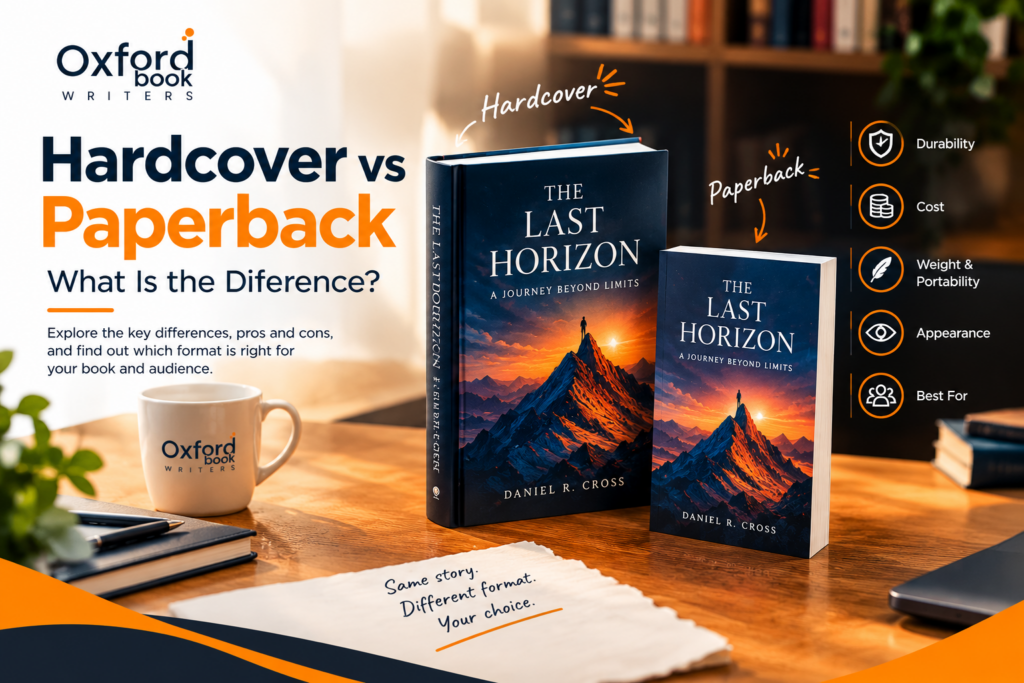
Choosing the right book format is an important decision for both readers and authors. The most common options are hardcover and paperback, and while both contain the same story or information, they differ in construction, durability, cost, weight, and presentation.
The main difference in hardcover vs paperback is the cover itself. Hardcover books use a rigid cover, usually made with thick board, while paperback books use a flexible paper or cardstock cover. That simple difference affects how the book feels, how long it lasts, how much it costs, and how it is positioned in the market.
If you are an author preparing a book for publication, understanding hardcover vs paperback can help you choose the format that fits your audience and publishing goals.
Hardcover vs Paperback at a Glance
| Feature | Hardcover | Paperback |
| Cover | Rigid and thick | Flexible |
| Durability | High | Moderate |
| Weight | Heavier | Lighter |
| Price | Usually higher | Usually lower |
| Portability | Less convenient | Easier to carry |
| Appearance | Premium | Practical |
| Best For | Collectors and gifts | Everyday reading |
| Production Cost | Higher | Lower |
What Is a Hardcover Book?
A hardcover book has a rigid outer cover that protects the pages inside. The cover is generally made from thick board and may have printed paper or a dust jacket over it.
Hardcover books are commonly associated with premium editions, new releases, collector’s editions, gifts, and books that are expected to receive frequent handling.
Because the construction uses stronger materials and requires additional production steps, hardcover editions generally cost more than paperback editions.
For authors, hardcover can also give a book a more professional and premium appearance, especially when the book is intended to become a long-term part of an author’s brand.
What Is a Paperback Book?
A paperback book, also called a softcover book, has a flexible outer cover. The cover is usually made from paper or cardstock and is attached to the interior pages using a binding method such as perfect binding.
Paperbacks are lighter and generally less expensive to produce than hardcovers. This makes them popular for novels, nonfiction books, travel reading, and everyday use.
When comparing hardcover vs paperback, paperback is often the practical choice for readers who want a lower-priced and portable physical book.
What Is the Difference Between Hardcover and Paperback?
The biggest difference between hardcover vs paperback is the construction of the cover.
A hardcover has a rigid structure that provides additional protection to the pages. A paperback has a flexible cover that bends more easily and is lighter to carry.
There are also differences in:
- Durability
- Manufacturing cost
- Retail price
- Weight
- Portability
- Appearance
- Shelf presentation
- Target audience
The right option depends on what the reader or author values most.
Hardcover vs Paperback: Cover and Binding
Hardcover books use a rigid board cover, while paperbacks use a flexible cover.
The rigid construction of a hardcover helps protect the book from bending and general wear. Paperbacks are more flexible, which makes them easier to carry but also means the cover can bend or crease more easily.
Paperback production is generally simpler and less expensive, while hardcover production requires additional materials and construction.
Hardcover vs Paperback: Durability
Durability is one of the biggest reasons readers choose hardcover.
A hardcover’s rigid exterior provides greater protection against bending and repeated handling. This makes hardcovers a popular option for libraries, collectors, and readers who plan to keep a book for many years.
Paperbacks can still last for years when they are handled carefully. However, their flexible covers are more susceptible to creasing, bending, and general wear.
Do Hardback Books Last Longer?
Generally, yes. A well-made hardcover will usually last longer than a paperback because its rigid cover provides more protection.
However, the lifespan of either format depends on more than the cover. Binding quality, paper quality, storage conditions, and how frequently the book is handled can all affect its condition.
So if durability is your biggest priority in the hardcover vs paperback decision, hardcover usually has the advantage.
Hardcover vs Paperback: Cost
Cost is another major difference.
Hardcover books generally cost more because they require rigid cover materials and more involved production. Paperbacks are usually less expensive because they use simpler materials and binding.
For readers who buy many books, paperback can therefore be a more economical option.
For authors, the production budget is an important consideration. A paperback may provide a lower-cost physical edition, while a hardcover can be positioned as a premium version.
Hardcover vs Paperback: Weight and Portability
Paperbacks are normally lighter than hardcovers.
If you regularly carry books to work, school, on flights, or while traveling, paperback can be more convenient. Its flexible cover also makes it easier to fit into bags.
Hardcovers are heavier and more rigid. They take up more space, but that additional structure provides a sturdier reading experience.
This is one reason many readers prefer paperback for everyday reading.
Hardcover vs Paperback: Appearance
Hardcover books generally have a more premium appearance.
They can look impressive on a bookshelf and are often selected for special editions, gifts, collectible books, and important new releases.
Paperbacks have a simpler appearance but can still have excellent cover designs and professional production quality.
For authors who want their book to make a strong visual impression, hardcover can be an attractive option.
Are Hardcover Books Worth It?
Hardcover books can be worth the extra cost if you care about durability, appearance, collecting, or long-term ownership.
A hardcover may be a good choice if:
- You want a premium edition
- You are buying a gift
- You plan to keep the book for years
- You collect physical books
- You want stronger protection
- You prefer a more substantial physical book
On the other hand, paperback may offer better value if your main priorities are affordability and portability.
There is no single winner in the hardcover vs paperback comparison. It depends on what you want from the book.
Is It Better to Buy a Hardcover or Paperback?
The answer depends on your priorities.
Choose a hardcover if you want:
- Better durability
- Premium presentation
- A collectible edition
- A strong gift option
- Long-term storage
Choose a paperback if you want:
- A lower price
- Lightweight reading
- Better portability
- A flexible cover
- An affordable everyday edition
For most casual readers, paperback offers excellent practicality. For collectors and readers who value durability, hardcover may be worth the additional cost.
What’s the Difference Between Hardcover and Paperback on Amazon?
When shopping on Amazon, hardcover and paperback are normally listed as different formats of the same book.
The content may be identical, but the physical specifications can differ. The two editions may have different prices, dimensions, page counts, publication dates, and availability.
Hardcover editions generally cost more because of their construction, while paperbacks are typically positioned as the more affordable format.
For authors, publishing both formats can be a useful way to reach different types of readers.
How Can I Convert a Paperback Book to a Hardcover?
You generally cannot convert a paperback into a hardcover simply by replacing its cover. A hardcover edition requires appropriate binding and cover construction.
For an author, the better approach is usually to create a separate hardcover edition using the correct cover dimensions, spine measurements, interior specifications, and formatting requirements.
The same manuscript can often be used as the foundation for both editions, but the files need to be prepared correctly for each format.
This is especially important when publishing professionally because incorrect spine width or cover dimensions can affect the final printed book.
Hardcover vs Paperback for Authors
The hardcover vs paperback decision is not only important for readers. Authors also need to consider which format fits their book and business goals.
Before choosing a format, consider these factors:
Your Target Audience
Think about who is most likely to buy your book.
A novel aimed at price-conscious readers may perform well as a paperback. A premium business book, memoir, gift book, or collectible edition may benefit from a hardcover option.
Your Budget
Production costs matter when planning a publishing budget.
If keeping the physical book affordable is important, paperback may be the better starting point. If premium presentation is more important, hardcover may justify the additional investment.
Your Genre
Different genres can have different format expectations.
Fiction novels are commonly available in paperback, while business books, memoirs, illustrated books, and special editions can benefit from hardcover presentation.
Your Distribution Plan
Authors should also consider where the book will be sold and which formats their publishing and distribution setup supports.
Should Authors Publish Both Hardcover and Paperback?
For many authors, offering both formats can be a strong strategy.
Paperback gives readers an affordable and portable option, while hardcover provides a premium alternative.
Oxford Book Writers currently supports formatting and typesetting for eBook, paperback, and hardcover editions as part of its publishing services.
Authors who are still deciding how to approach the publishing process can also explore this guide on book writing companies in the USA to understand what professional book writing companies typically offer.
Publishing both formats can give readers more choice without requiring you to create an entirely different manuscript.
Which Format Should You Choose?
Here is a simple comparison:
| Your Priority | Recommended Format |
| Lower price | Paperback |
| Easy travel | Paperback |
| Lightweight reading | Paperback |
| Premium appearance | Hardcover |
| Long-term durability | Hardcover |
| Collecting | Hardcover |
| Gifting | Hardcover |
| Maximum reader choice | Both |
Authors should also consider professional printing specifications before finalizing their format. This hardcover vs paperback guide provides another useful comparison of the two formats.
Final Thoughts
The hardcover vs paperback choice comes down to price, durability, portability, appearance, and purpose.
Hardcovers offer a rigid construction, stronger protection, and a premium feel. Paperbacks are lighter, more flexible, and generally more affordable.
For readers, the best choice depends on personal preference. For authors, the decision should also take into account the target audience, genre, budget, distribution strategy, and positioning of the book.
In many cases, publishing both edition Oxford Book Writers can be the best approach because it allows readers to choose the format that suits them.
FAQs
What is the main difference between hardcover and paperback?
Hardcover books have rigid covers while paperback books have flexible covers. This affects durability, weight, price, and appearance.
Do hardback books last longer?
Generally yes. Hardcovers usually provide better protection and durability than paperbacks.
Are hardcover books worth it?
They can be worth it if durability, premium appearance, collecting, or gifting is important to you.
Is paperback cheaper than hardcover?
Usually yes. Paperbacks generally cost less to produce and purchase.
What’s the difference between hardcover and paperback on Amazon?
They are different physical editions that can have different prices, dimensions, page counts, and availability.
Is it better to buy a hardcover or paperback?
Choose hardcover for durability and premium presentation. Choose paperback for affordability, portability, and everyday reading.
Can authors publish both hardcover and paperback?
Yes. Offering both formats allows authors to serve readers with different preferences and budgets.